
Why U.S. Companies Are Investing in VR Training Instead of Traditional Training Programs
Picture this. A new employee walks onto a manufacturing floor. It’s their first week on the job. A supervisor hands them a printed manual and says, “Read through this. You’ll be fine.
That approach has defined workplace training for decades. And for decades, it has fallen short.
Today, companies across the United States — in manufacturing, healthcare, aviation, and construction are replacing outdated methods with Virtual Reality. The results speak for themselves.
The Problem with Traditional Training That No One Talks About Enough
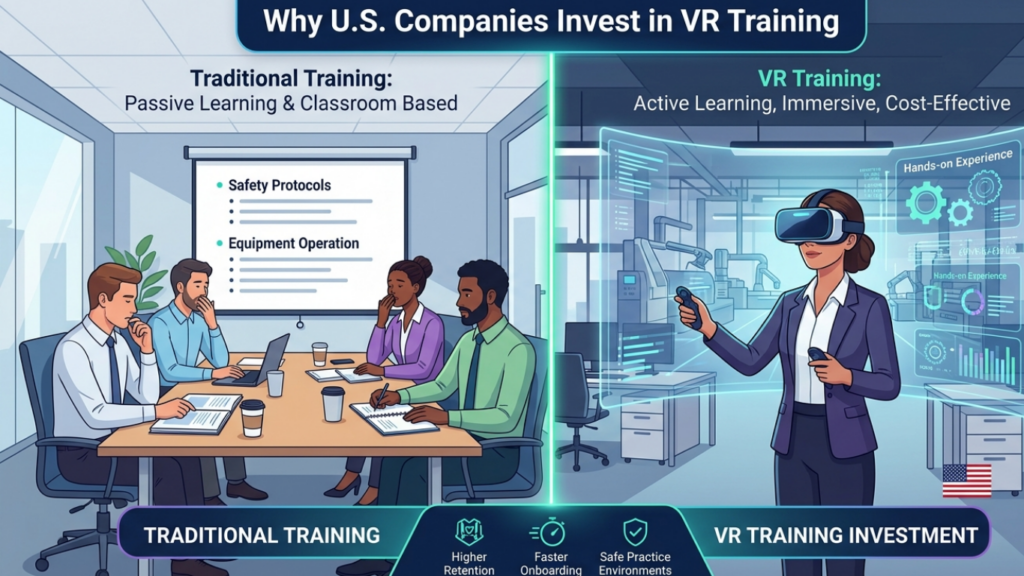
Traditional training has always had a core flaw: it tells employees what to do without letting them practice it.
Classroom lectures, slide decks, and training videos are passive experiences. Employees watch, take a quiz, collect a certificate, and move on. Research shows people retain only 20% of what they hear and 30% of what they see. Most of the training budget is quietly going to waste.
The hidden costs add up fast:
High turnover linked to weak onboarding
Re-training expenses when employees forget what they learned
Workplace errors caused by poor preparation
Lost productivity from repeated training cycles
Compliance risks when knowledge gaps go undetected
What VR Training Actually Does Differently
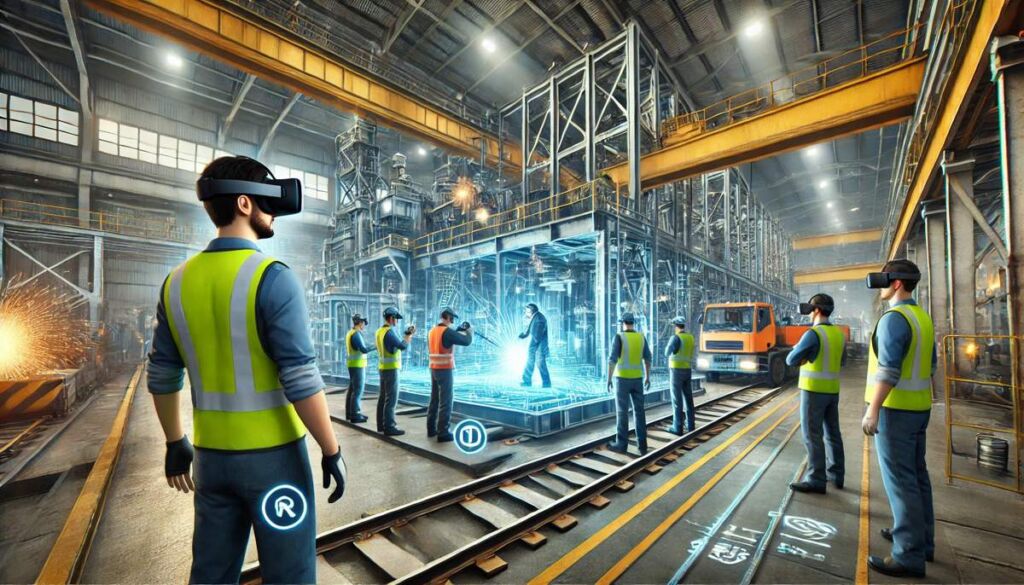
VR puts employees inside the experience. Instead of watching someone operate equipment, the trainee operates it themselves — in a simulated environment that looks and responds like the real thing.
This shift from passive to active learning is why VR works. The brain stores information more deeply through experience than observation. Studies show VR-trained employees retain knowledge at rates of 75% to 90%. That is a dramatic improvement over any traditional method.
VR also removes all risk. Trainees can make mistakes, repeat steps, and practice difficult scenarios as many times as needed. There is zero danger to themselves, their colleagues, or company operations. Think of it like elite athlete training — the more realistic the rehearsal, the better the real-world performance.
A Real Shift Happening Across U.S. Industries
This is not a future trend. It is happening right now:
Healthcare — Surgeons, nurses, and emergency teams rehearse complex procedures before entering real clinical settings. This improves both accuracy and confidence.
Manufacturing & Industrial — Companies build virtual replicas of their facilities. New hires train on actual equipment without stopping production or creating safety hazards.
Aviation — Simulation-based training has been standard for pilots for years. VR now extends that same approach to ground crews and maintenance teams.
Corporate & Soft Skills — AI-powered VR simulations prepare employees for high-stakes conversations. These include sales pitches, performance reviews, and conflict resolution.
Construction & Engineering — Workers practice hazard identification in virtual job sites. They do this before ever stepping onto a live project.
When an entire cross-section of American industry moves in the same direction, it is worth paying attention.
The Incident That Changed How One Industry Thought About Training
On July 6th, 1988, an explosion on the Piper Alpha oil platform killed 167 workers. It destroyed the rig within hours. Investigations pointed to a maintenance failure — a missed step and a process that relied on human memory and paper checklists.
The workers had been trained. They had their certifications. But classroom preparation was not enough when the real emergency hit.
That disaster reshaped safety culture across the energy industry. It raised a question every industry should ask: what happens when training is not immersive enough? VR is increasingly the answer. It does not just teach procedures — it builds the practiced familiarity that holds up under pressure.
The Business Case Is Getting Harder to Ignore
For a long time, cost was the primary objection to VR training. The hardware seemed expensive. The software development seemed complex. The ROI seemed uncertain.
That calculation has changed significantly.
Once a VR training module is built, it can be deployed to thousands of employees across multiple locations at virtually no additional cost. There are no travel expenses, no instructor fees, no printed materials to update, and no facility rentals. Updates to training content are made digitally and distributed instantly.
A 2020 PwC study found that VR-trained employees completed training four times faster than classroom learners and were 275% more confident in applying what they learned. Meanwhile, companies using VR for safety training have reported meaningful reductions in workplace incidents and associated costs.
For large U.S. enterprises managing distributed teams across multiple states, time zones, and facilities, the scalability of VR is not just a benefit. It is a strategic advantage.
Consistency Is the Hidden Advantage
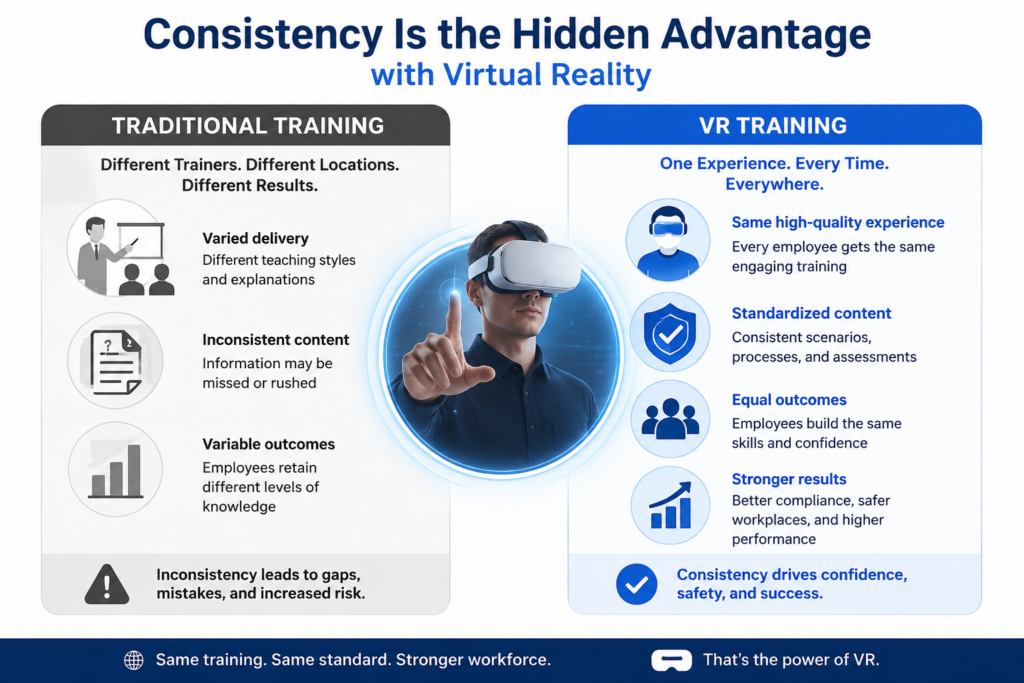
Traditional training is inconsistent by nature. The same program run by different instructors produces different outcomes. Some employees get a thorough session. Others get something rushed and forgettable.
VR removes that variability. Every employee — in North Carolina, California, or Texas — goes through the exact same experience. Same scenarios, same standards, same quality, every time.
This matters most for regulatory compliance. In healthcare, manufacturing, and financial services, training must meet documented standards across every employee. VR makes that auditable in ways instructor-led training simply cannot.
How Red Stone USA Inc. Is Supporting This Transition
At Red Stone USA Inc., we work with U.S. businesses to design, deploy, and scale enterprise VR training programs backed by the right hardware, software, and support infrastructure.
Our portfolio includes GWPro, which delivers immersive simulation-based training for industrial and high-risk environments, and Metaverse Learning, which enables scalable virtual learning environments for enterprise teams. For organizations focused on soft skills and professional development, Imersifi and VirtualSpeech provide AI-powered coaching and communication training through fully immersive VR experiences.
On the hardware side, we supply Meta Quest headsets, Pico devices, and enterprise-grade accessories all fully kitted, provisioned, and managed through MDM solutions including ManageXR, ArborXR, and Pico Business Suite.
Whether you are training 20 employees or 20,000, we build solutions that fit your workforce, your industry, and your goals.
The Window to Move First Is Still Open
The companies investing in VR training today are not doing it because it is new or exciting. They are doing it because the evidence is clear: it trains faster, retains better, scales further, and costs less over time than the methods it replaces.
Traditional training had its era. That era is ending.
The organizations that move now will build more capable, more confident, and more resilient workforces. Those that wait will spend the next few years watching competitors close the gap from the other direction.
If you are ready to explore what VR training can do for your business, the team at Red Stone USA Inc. is ready to help you build it. Reach out to us today — let’s design a training strategy that actually works.